


Fabrics and Garments
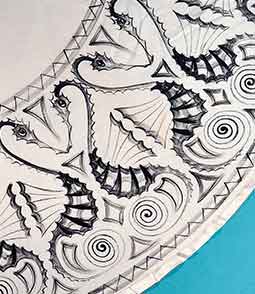
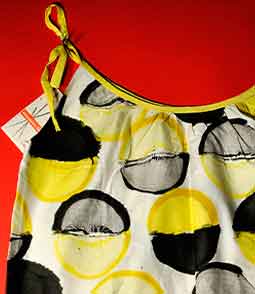
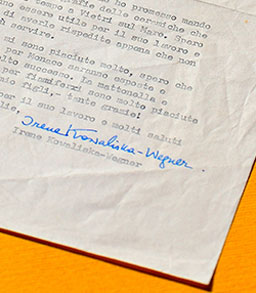
Lamberto Tastardi, known artistically as “Luciano”, began working as a decorator with the best ceramic factories in Salerno — including D’Agostino, Ernestine, and Musa in Vietri — after his studies with Professor Rossi from 1940 to 1955. In 1955, he launched his own workshop and founded “Creazioni Luciano”. He devoted himself to hand-painted fabrics, translating the bold, swift brushstrokes of ceramic decoration into textiles. He developed a unique hand-printing technique, dipping self-made stamps — created from tire inner tubes — into colors to produce abstract patterns. His draperies, exhibited at trade fairs such as SAMIA and MITAM, caught the attention of renowned architect Giò Ponti, who, impressed by the craftsmanship, wrote him a letter from the editorial office of Domus expressing his appreciation.
Thick Glass Ceramics
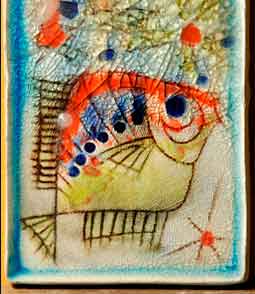
These ceramics are distinguished by the use of a white earthenware body, often refractory, to withstand the expansion of the thick glassy layer applied on top. Colors were applied to the surface, followed by a very thick glass glaze. The pieces, sometimes in relief, sometimes engraved, and sometimes plain, featured figurative or abstract designs. A key characteristic of this technique lies in the unpredictable behavior of glazes during firing, creating smudges and chromatic variations that make each piece unique. This method was eventually abandoned due to a high rejection rate.

The Black Style
Engraved designs reveal the natural white color of the ceramic body and stand out sharply against a dark, uniform background. Vivid hard glazes depict fantastical motifs such as twin-tailed mermaids, deep-sea creatures, or oriental-inspired peacocks.

Ceramic Cloisonné
Luciano invented a new technique that became his hallmark in Italy and abroad, reminiscent of the cloisonné used in jewelry making. It involves embossed designs enclosed in borders and manually filled with colored glazes, which melt and spread evenly during firing. Similar in concept to stained glass windows, it uses white clay (instead of the red commonly used in Vietri), which enhances the drawing and provides a perfect base for vibrant glassy glazes. This technique was used to reimagine an ideal world inspired by traditional iconography — rural scenes, fishermen, Moorish and Mediterranean houses. The artist Irene Kowaliska was so impressed by Luciano’s technique that she gifted him photos of her own ceramics, inviting him to reinterpret them with this new cloisonné method.

…of Irene Kowaliska
“From 1940 to 1943, I was reproducing his and Giò Ponti’s designs for D’Agostino; from 1946 to 1950 for Musa Ceramics in Vietri; and from 1955 to 1960 independently for Miricae, a client of mine on Via Frattina in Rome. In the 1960s and ’70s, he was a supervisor for ENAPI and often visited my studio. He was deeply interested in my new decorative relief technique, born from my passion for stained glass and translated into ceramics with colored windows. He particularly appreciated the ‘Mediterranean Houses’ series in Arab-Moorish style. Pleased with the results, he gave me photos of his ceramics with Sardinian-Vietrese fairytale characters so I could reinterpret them using my new cloisonné technique. He would later return, happy to see the results in a renewed decorative form…”

Large-Scale Landscape Panels. After the Crystalline…
After experimenting with colored crystalline glazes, Luciano turned to creating large-scale landscape panels. Using a similar technique, he refined his drawing and employed matte colors and glazes, giving the pieces a soft, satin finish. Produced in limited series, these panels depicted iconic Italian monuments and became true ceramic paintings, with pastel tones evoking both fine art prints and 18th-century gouaches reimagined in ceramic.

Continuity
Luciano Jr., Roberto, and Enrico — sons of “Luciano” — have long carried on the family tradition. Luciano Jr. manages the business side, while Roberto and Enrico focus on artistic direction. Over two decades, they have brought meaningful innovations to the workshop, creating thousands of new designs ranging from simple souvenirs to large ceramic panels. Alongside the traditional artistic ceramics, they have launched a new brand dedicated to high-quality ceramic tiles and coverings: “Ceramiche Tastardi”. This new line combines the traditional craftsmanship of the original workshop with a fresh direction in ceramic production.


Prestige
Presentation video of the 2012 London Olympics broadcast worldwide: during the countdown, the Liberty-style numbers (number 13) were created by Creazioni Luciano.